AI Layoffs in 2026: What the Data Actually Shows
Jun 25, 2026 · Updated Nov 6, 2026 · 62 min read · AI Layoffs
The honest field guide to how much of the 2026 layoff wave is really AI, and how much is something else wearing an AI label.
Updated November 6, 2026: Challenger's figures now run through October. AI-cited cuts fell to 1,265, the lowest month of the year, and market and economic conditions overtook AI as the leading reason for 2026. Register and index readings elsewhere in this guide are as of October 20.
Updated October 20, 2026: rewritten on the data through September 2026. The first version, from June, ended with AI-cited layoffs still climbing; they peaked in May and fell sharply over the summer. Every figure from Challenger, the register, the index and the labor market is now current, the company examples follow the register's latest reading of each cut, the Stanford early-career study is described with its August 2026 edition, and an earlier claim that the gap between recent graduates' and all workers' unemployment was the widest on record has been corrected (the record in the New York Fed's series is April 2025).
Corrected October 9, 2026: Intuit's, Walmart's and Verizon's cuts now carry what each company said about AI. Intuit's chief executive said the cut had nothing to do with AI, Walmart said its changes were not about handing more tasks to AI, and Verizon said its November 2025 cuts were not the result of its use of AI; the Walmart citation now links to a free source.
Corrected October 8, 2026: three citations to subscriber-only articles now link to free sources. The MIT figure now reads as the July 2025 report states it (95% of organizations getting zero return from generative AI), the 2026 spending plans are dated to April with each company's figure as reported, and a McKinsey projection that no free source carried was removed.
Corrected October 1, 2026: an earlier version said Salesforce framed "about 4,000 support cuts" around its AI agents. Its CEO described support headcount falling from about 9,000 to 5,000, which Salesforce said came largely from not refilling roles and moving people to other teams, so the register no longer counts the 4,000 as layoffs.
From January through October 2026, US employers named artificial intelligence in 121,401 announced job cuts, about 20% of every layoff announced this year and more than twice the 54,836 they attributed to AI in all of 2025 - Challenger, Gray & Christmas. That total hides the most important fact about the year: it was built in the spring. AI-cited cuts hit a record 38,579 in May, 40% of that month's layoffs, then fell to 3,462 in August, 3,961 in September and 1,265 in October, the lowest month of the year - Challenger, Gray & Christmas. The year-to-date figure is now quoted in nearly every story about AI and work, and it is doing an enormous amount of unexamined labor. It is treated as proof that the machines have arrived. It is also, on its own, close to meaningless.
The problem is not that the number is fake. It is real, it more than doubled last year's in ten months, and we track it closely. The problem is that an announced cut is not an executed cut, a cut a company blames on AI is not the same as a cut AI caused, and a press release optimized for investors is not a measurement. Strip those three confusions apart and the picture changes from "robots took 120,000 jobs this year" to something quieter, more concentrated, and frankly more useful to know.
This is the deep briefing from the AI Layoffs Index, an independent tracker built on one idea: that the question "is AI taking jobs?" deserves a number you can audit rather than a narrative you have to trust. This guide walks through what the public data actually shows as of early November 2026, where the headline overstates reality, where the signal is genuinely real, and how a single 0 to 100 index turns a pile of contradictory sources into one honest reading. It assumes no technical background. It does assume you would rather have the defensible answer than the dramatic one.
Contents
- The number everyone quotes, and what it leaves out
- First principles: what cheap intelligence actually changes
- Said is not caused: the AI-washing problem
- Announced is not executed: the reversal gap
- Where the signal is real: the payroll evidence
- The capex paradox: cutting people to fund machines
- A sector tour of who is cutting and why
- The counter-evidence: is the AI even working yet?
- How we turn all of this into one honest number
- What to watch over the next year
- The bottom line for workers, companies, and policymakers
1. The number everyone quotes, and what it leaves out
Every serious conversation about AI and jobs starts with the same source, so this guide will too. The outplacement firm Challenger, Gray & Christmas has tracked employer-announced layoffs for decades, and in 2023 it began coding the reason employers give, including a separate line for cuts attributed to artificial intelligence. That series is the closest thing the labor market has to a real-time AI dashboard. AI-cited cuts ran to 4,247 in 2023 (from May, when the line began), then 12,742 in 2024, then 54,836 in all of 2025 - Challenger, Gray & Christmas. Through October 2026 the figure stands at 121,401, about 20% of all layoffs announced this year, and with 130,531 cuts market and economic conditions have overtaken AI as the leading reason for the year as a whole - Challenger, Gray & Christmas.
The annual view makes the step up impossible to miss: ten months of 2026 already hold more than twice the AI-cited cuts of all of 2025.
Inside 2026, the monthly path tells a different story from the annual jump, and it is the story the year-to-date figure hides. AI was named in 7,624 cuts in January and 4,680 in February, then 15,341 in March, 21,490 in April and a record 38,579 in May. It led every stated reason for five straight months, March through July. Then the line fell: 14,029 in June, 10,970 in July, 3,462 in August, its lowest month since December 2025, as AI dropped to the fourth most cited reason, 3,961 in September, when it was fifth - Challenger, Gray & Christmas, and 1,265 in October, the lowest month of the year - Challenger, Gray & Christmas. Almost two thirds of the year's AI-cited total, about 75,000 cuts, was announced in March, April and May.
The share of all cuts traces the same arc, and a share controls for the size of the overall layoff wave. AI went from naming 7% of cuts in January to 40% in May, held near a third in June and July, then fell back to 7% in August, 9% in September and 3% in October - Challenger, Gray & Christmas. In the spring, a rising share inside a falling total looked like the signature of a reason displacing every other explanation. By the end of the summer, the same measure was back where the year began, and by October it was below it.
Why the line fell is the first open question of the second half, and the data supports three readings at once rather than one. The first is the economy: all announced cuts fell to 129,591 in the third quarter, down 43% from 226,242 in the second, and Andy Challenger described employers as being in "a wait-and-see period right now" - Challenger, Gray & Christmas. Fewer layoffs of every kind means fewer AI-labelled ones, and by October he read it as a change of reason too: "The reasons employers give have shifted from technology to the economy" - Challenger, Gray & Christmas. The second is lumpiness: the spring total was carried by a run of very large announcements, and our own event register logged 42 AI-linked cuts with a May date against 11 in August, so a few quiet months for big employers move the series a long way. The third is the label itself, which section 3 takes apart: after a spring of scrutiny, several large employers went out of their way to say a cut was not about AI, while others began describing AI shrinking their headcount through attrition, which never shows up as an announced layoff at all. None of the three says AI's effect on work has eased. Each says the announcement count is a poor instrument for measuring it.
Here is what the headline also leaves out, and it is a big one. Total announced US cuts reached 617,189 through October, down 44% from the 1,099,500 announced in the same months of 2025 - Challenger, Gray & Christmas. Overall layoffs are falling, not rising. The 2025 comparison is inflated by federal workforce reductions, but the underlying point survives: in 2026 AI became a much larger share of a shrinking pie, mostly in one season. That is a genuinely different story from "AI is causing a layoff surge."
The second thing the headline leaves out is concentration. The technology sector alone announced 171,501 cuts through October, up 21% from the same period of 2025 and 28% of every cut announced this year, more than any other industry - Challenger, Gray & Christmas. The AI-jobs story, at least as it appears in the announcement data, is overwhelmingly a tech and tech-adjacent story, not a uniform sweep across retail, construction, health care, and education. Any honest reading has to hold those facts together: the AI line climbed fast and then fell back, inside a falling, sector-concentrated total. The raw number is the start of the analysis, not the end of it.
2. First principles: what cheap intelligence actually changes
Before touching another statistic, it is worth stopping to reason about the mechanism, because most commentary skips this step and goes straight to counting press releases. The structural question is not "which companies are cutting?" It is "what does it change when one specific input, cognitive labor, gets radically cheaper?" Markets do not buy "AI." They buy outcomes: a support ticket resolved, a contract reviewed, a sales lead qualified, a line of code shipped, a payroll run reconciled. Each outcome is produced by bundling together capital, software, data, and human cognition. When the price of one input in that bundle collapses, the firms reorganize the bundle. The interesting question is always which tasks the cheap input can now absorb, not which job titles sound vulnerable.
This reframing matters because jobs are bundles of tasks, and AI does not consume jobs, it consumes tasks. A junior analyst role might be 60% "summarize, format, reconcile, draft" and 40% "judge, persuade, own a relationship, take responsibility." Current models are very good at the first bundle and weak at the second. So the first-order effect of cheap intelligence is not that the role vanishes, it is that the task mix inside the role shifts until, at some firms, the residual human tasks no longer justify a separate headcount at the entry level. This is why, when you look at real data later in this guide, the damage shows up exactly where task bundles are most automatable and least anchored by relationships or accountability: the bottom rung of cognitive work.
The capability backdrop in 2026 is what makes this more than a thought experiment, because the models crossed a threshold from "drafting assistant" to "agent that completes multi-step work." By mid-2026 the frontier systems were built explicitly around taking actions, not just answering questions. Anthropic's Claude Opus 4.8, released on May 28, 2026, is positioned as a computer-use and browser agent and scores 84% on the Online-Mind2Web benchmark - Anthropic. OpenAI shipped GPT-5.5 on April 23, 2026, reporting 82.7% on Terminal-Bench 2.0 with gains aimed at agentic coding and knowledge work - Wikipedia. Google released Gemini 3.5 Flash on May 19, 2026, pairing it with a Computer Use tool in public preview - Google. The common thread is that all three providers sell action, not just text.
There is a crucial lag built into this mechanism, and it explains why the layoff data looks early and patchy rather than mature and uniform. A capability arriving in a model is not the same as a capability arriving in a company's workflow, because deployment requires integration, trust, and process redesign that take quarters or years, not a weekend. The US Census Bureau's biweekly Business Trends and Outlook Survey found 23.8% of US firms using AI in the collection that ended September 20, 2026, up in three straight collections from 21.8% in early August, with the Information sector the furthest along at 49.0% - US Census Bureau. Most of the economy has not yet rebuilt itself around these tools, which is precisely why the employment effects so far are concentrated in the firms and roles furthest along the adoption curve. The cuts you are reading about are a leading edge, not a finished transition, and a leading edge is easy to mistake for either a wave or a mirage depending on your priors.
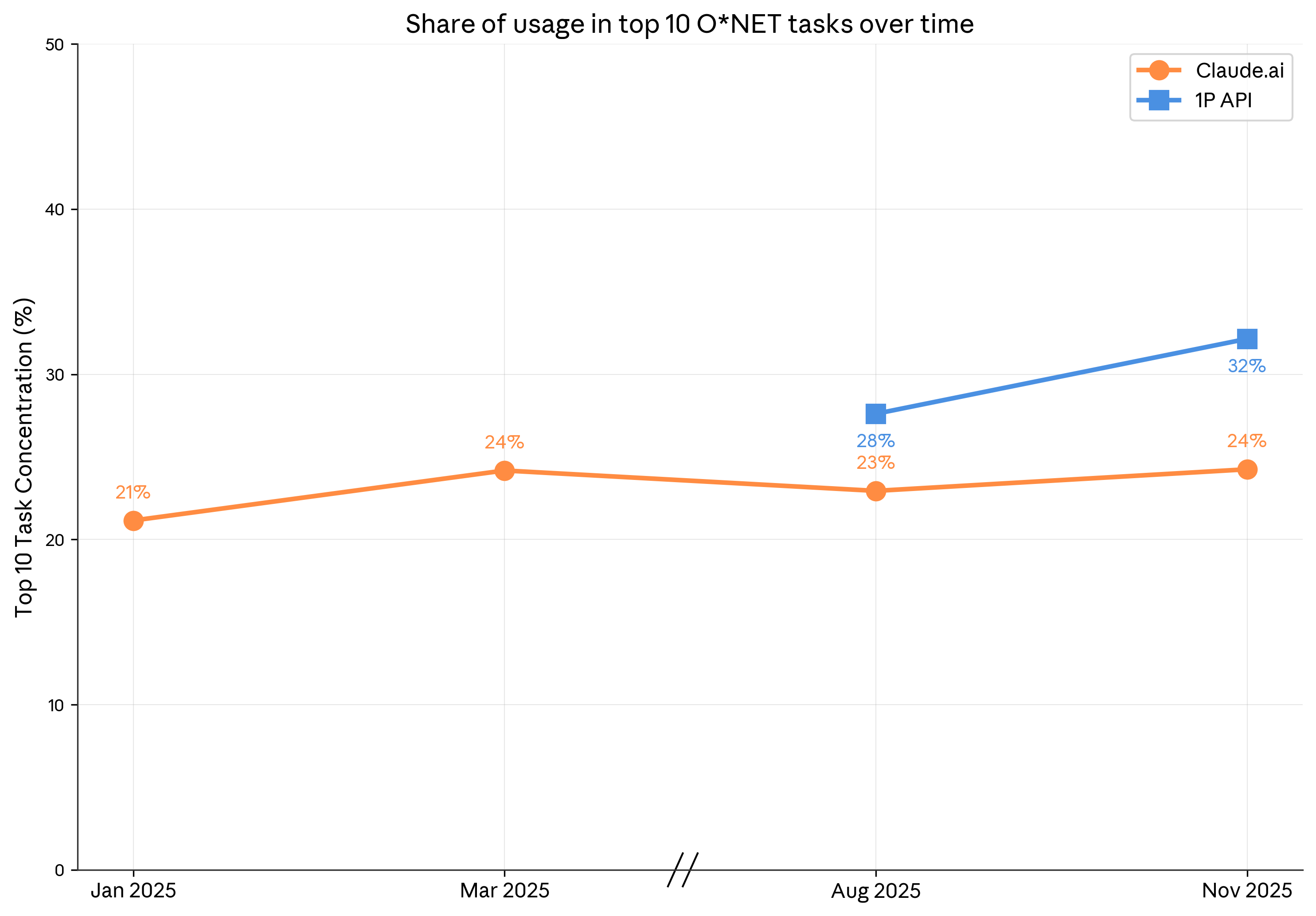
What companies actually do with the models, when it is measured rather than announced, complicates the replacement story further. The Anthropic Economic Index, which reads anonymized usage patterns, found that by late 2025 augmentation had overtaken automation, with 52% of Claude.ai conversations collaborative versus 45% fully delegated, a reversal from earlier in the year - Anthropic. Its May 2026 data still put augmentation narrowly ahead, at 51.4% of conversations against 48.6% - Anthropic Economic Index data. At the level of individual tasks, in other words, the dominant pattern is a human and a model working together, not a model working alone. That is consistent with a world where AI raises the output of the worker who keeps their job more than it eliminates the worker outright, which is a very different near-term labor story from wholesale replacement.
What people actually use the models for
The most underappreciated metric in this whole debate is not a layoff count, it is a capability trend. The research nonprofit METR found that the length of software tasks AI agents can finish at a 50% success rate is doubling roughly every 88 to 131 days for recent models - METR. Translate that out of benchmark language: the horizon of "work an agent can complete unsupervised" is expanding from minutes toward hours, and on a compounding schedule. That curve, not last month's headline, is what executives are actually pricing in when they restructure. It is also why so much of the displacement is being justified by anticipated capability rather than demonstrated results, a gap we will return to, because it is the single most important caveat in the entire story.
To make that capability concrete rather than abstract, it helps to define what agentic actually means, because the word is doing heavy lifting in every layoff rationale. A chat model answers a question. An agent is handed a goal, then plans, takes actions across tools and websites, checks its own work, and iterates until the goal is met or it gets stuck. That shift from answering to doing is what turns a productivity aid into a potential headcount substitute, because a job is mostly a sequence of actions, not a sequence of answers. The usage data shows how far this has already spread: Anthropic reports that about 49% of jobs have had at least a quarter of their tasks touched by Claude, with computer and mathematical work the single largest category at roughly 35% of conversations - Anthropic. The models are not waiting politely at the edge of the economy. They are already inside a large share of cognitive work, mostly assisting today, increasingly acting tomorrow.
3. Said is not caused: the AI-washing problem
Now to the largest distortion in the headline number, and the one most commentators wave away. When a company lays people off, "we are reorganizing around AI" is simply a better story to tell than "we over-hired during the 2021 boom" or "demand softened and rates rose." The first is forward-looking and makes the firm sound like a winner of the future. The second is an admission. Given a choice between a flattering narrative and an unflattering one for the same underlying event, executives and investor-relations teams choose the flattering one, and AI is now the most flattering available reason. Analysts have a name for the result: AI-washing, the labor-market cousin of greenwashing.
This is not speculation, it is survey-measured. A December 2025 Resume.org survey of 1,000 US hiring managers found that 59% admit they emphasize AI when explaining layoffs because it plays better with stakeholders than citing financial constraints - Resume.org. In the same survey, only 9% said AI had fully replaced specific roles, and 45% reported little to no staffing impact from AI at all. Read that carefully. A majority of the people writing the layoff explanations concede that the AI framing is a communications choice, not a cause. The Challenger AI-cited series is, by the admission of the managers feeding it, contaminated by narrative.
The single best one-line summary of the dynamic comes from Challenger itself, and it is more precise than it first sounds. "Regardless of whether individual jobs are being replaced by AI, the money for those roles is," said Andy Challenger - CBS News. That is the mechanism stated honestly. In many cases AI is not performing the laid-off worker's tasks at all. The budget that funded the worker is simply being redirected toward AI infrastructure and AI hiring. The role dies so the capex can live. That is a real economic effect of AI on employment, but it is a completely different effect from "a model now does this job," and conflating the two is how the discourse goes wrong.
Zoom out to the full 2025 picture and AI shrinks further as a named cause. Of the 1,206,374 total US cuts announced in 2025, AI was cited for just 54,836, about 4.5%, while market and economic conditions accounted for 253,206 and federal DOGE-related actions for 293,753 - Challenger, Gray & Christmas. The chart below puts those named reasons side by side, and it is a useful antidote to the impression that AI is the dominant driver of layoffs. It is not, at least not by what employers say out loud.
Our own register makes the same point one event at a time, because it records what each employer actually said rather than the reason a headline assigned. Of the 182 AI-linked job cuts it holds for 2026, at 175 employers, the employer itself said AI was the reason, without citing other material factors, in only 16, covering 4,943 of the 188,537 roles reported across all of them. In 112 more it named AI among other reasons, usually cost, restructuring or "operating model". In 48, only the press made the link, and in 5 of those the employer denied it outright - AI Layoffs register. The short list of employers that said AI took over work their staff did, in their own words, is on our page answering which companies are replacing workers with AI. The largest cuts where the employer named AI as the sole reason were small by headline standards: Allianz Partners' 1,500 European call-centre and assistance roles, tied by its chief executive to the growing use of AI - Insurance Journal, and Cloudflare's 1,100.
The incentive to over-name AI is strongest precisely where the cut is least about AI. A company trimming an organization it over-built in the zero-interest-rate era gets to recast a painful correction as visionary efficiency, and the market frequently rewards the reframing with a higher multiple rather than punishing the layoff. You can watch the label travel loosely across very different situations: Block cut more than 40% of its staff, about 4,000 roles, describing the cut neutrally in its SEC filing while Jack Dorsey's letter to shareholders named AI-native teams as the driver - SEC, while Salesforce credited its AI agents for shrinking support from about 9,000 heads to about 5,000, largely by not refilling roles, even as it kept hiring aggressively in sales - Fox Business. Neither is fraudulent, and AI is a real part of each company's strategy. But the distance between "AI is part of our strategy" and "AI did this specific person's job" is exactly the distance a careful tracker has to preserve, and exactly the distance a headline collapses. The collapse is what manufactures the impression of an automation wave out of what is partly an ordinary cost cycle.
There is a twist that cuts the other way, though, and intellectual honesty requires naming it. The same labeling discretion that lets firms over-attribute to AI for glory also lets them under-attribute to AI for caution. Challenger has flagged that companies increasingly use a vaguer "technological update" label instead of naming AI directly: in the first half of 2025, only 75 cuts were explicitly tagged to AI versus roughly 20,000 tied to technological or automation updates - CFO Dive. As Andy Challenger put it, "some of the AI job cuts that are likely happening are falling into that category" of technological update. So the announcement data is biased in both directions at once, inflated by flattering AI-washing and deflated by cautious euphemism. That is precisely why no serious tracker can just republish the AI-cited figure and stop. The number needs correcting in both directions, which is the entire reason a blended index exists.
4. Announced is not executed: the reversal gap
The second distortion is simpler but just as important: Challenger counts what employers announce, and an announcement is an intention captured at its most confident moment, not a payroll outcome. Plans slip, plans shrink, and plans get quietly reversed when reality pushes back. A measurement built on announcements therefore systematically front-runs reality, recording the bold press release and missing the embarrassed walk-back that follows months later. This is not a minor footnote. For a fast-moving narrative like AI, the gap between "we will automate this" and "we actually did, and it stuck" is where most of the exaggeration lives.
The cleanest cautionary tale is Klarna, because the company narrated both halves out loud. In 2024 it credited an OpenAI-powered assistant with doing the work of 700 customer-service agents, handling 2.3 million conversations and 75% of its chats, and it shrank headcount about 22% to roughly 3,500 people. Then in 2025 the CEO reversed course and resumed hiring humans, conceding the fully automated support was lower quality and that customers wanted a human option - Entrepreneur. The cut was real when announced and partly unwound in practice. Klarna is not unusual in doing this, it is unusual only in saying so.
A second example makes the same point in starker terms, because a union forced the numbers into the open. Commonwealth Bank of Australia announced in July 2025 that an AI voice bot would replace 45 customer-service roles, then reversed the decision on August 21, admitting the roles were "not redundant" after call volumes turned out to be rising, not falling - ACS Information Age. The bank had announced the cut on the strength of a projected AI capability, discovered the projection was wrong against real operational data, and walked it back. If a tracker had logged the announcement and never checked the outcome, it would carry 45 phantom AI job losses indefinitely.
The economics of why announcements run optimistic are worth spelling out, because they are structural rather than dishonest. A layoff announcement is made by leadership at the moment of maximum conviction, often to satisfy investors who want to see decisiveness, and it gets priced into the stock immediately. The execution happens months later, in the messy reality of legal notice periods, retention deals for the people you cannot actually afford to lose, and the discovery that the automated system is not as ready as the slide deck claimed. Every one of those frictions pushes the executed number below the announced one, and there is no symmetric force pushing it above, because companies rarely announce a small cut and then quietly fire many more. The result is a metric biased optimistic by construction, which is why a tracker that logs announcements without ever revisiting outcomes drifts steadily toward overstatement, like a scoreboard that records every shot taken as a goal.
None of this means the announced cuts are fictional, and it is just as wrong to dismiss every AI layoff as theater. The right interpretation is that the announced total is an upper bound on near-term reality, and the distance between announced and executed is itself a quantity worth tracking rather than assuming away. In our own event register we record an execution status for every entry, from announced to executed to reversed, and we weight reversed cuts down to near zero precisely because Klarna and Commonwealth Bank proved that the walk-back is a recurring feature, not a fluke. A promise to cut 30,000 jobs over five years should never land in a tracker the same way as 30,000 people already gone.
5. Where the signal is real: the payroll evidence
It would be easy, after two sections of debunking, to conclude that the AI-jobs story is all narrative and no substance. That conclusion would be just as lazy as the apocalypse it replaces, because there is a body of evidence that does not rely on what any company says about itself. The strongest comes from payroll records, which capture what actually happened to employment rather than what anyone announced. This is the part of the story that survives every correction, and it is the reason "nothing is happening" is as wrong as "everything is ending."
The landmark study is from the Stanford Digital Economy Lab, and its design is what makes it credible. Using high-frequency, individual-level payroll data from ADP, the largest US payroll provider, researchers Erik Brynjolfsson, Bharat Chandar, and Ruyu Chen asked not "who announced cuts?" but "whose employment actually moved?" Their answer is specific. In the November 2025 version of the paper, with data through September 2025, early-career workers aged 22 to 25 in the most AI-exposed occupations had seen a roughly 16% relative decline in employment since generative AI took off, while older workers in the same jobs and younger workers in less-exposed jobs held steady - Stanford Digital Economy Lab. The version before it, on data through July 2025, had reported 13%. The August 2026 edition, with data through June 2026, cuts both ways: its simple measure grew, with employment of 22- to 25-year-olds in the most exposed jobs now 19% below where it would be had it kept pace with their less exposed peers, up from 15% a year earlier, but its estimate with firm-level controls weakened and is no longer statistically significant for the most exposed group, which the authors attribute partly to changes in how they match ADP job titles to occupations - Stanford Digital Economy Lab. The direction of the simple gap is the clearest signal in the series; the size of the causal estimate is less settled than the 16% headline suggests.
The cleanest evidence we have

Two details in that finding matter enormously for interpretation, and they map exactly onto the first-principles argument from earlier. First, the decline shows up through reduced hiring rather than mass firing, which is why it is nearly invisible in the unemployment rate: companies are not marching juniors out the door, they are simply not bringing the next cohort in. Second, the effect concentrates in occupations where AI automates tasks rather than augments workers, which is exactly the task-bundle prediction: the roles that are mostly "summarize, draft, reconcile" are the ones thinning out. The canary is not the whole mine. It is the youngest worker in the most exposed room, and that is precisely where theory said to look.
The macro data, read carefully, corroborates the same concentrated pattern instead of contradicting it. Overall US unemployment was 4.2% in September 2026, down from 4.4% a year earlier - Bureau of Labor Statistics via FRED, which is why "nothing is happening" sounds plausible if you only glance at the top line. But underneath it, a historic reversal has occurred for the young and credentialed. Recent college graduates were unemployed at 5.7% in June 2026 against 4.1% for all workers, a gap of 1.6 points, up from 0.85 a year earlier and close to the 1.8-point record of April 2025 - Federal Reserve Bank of New York. For most of modern history a degree bought a lower unemployment rate: in the New York Fed's series, recent graduates were unemployed less often than the average worker in 342 of the 360 months from 1990 through 2019. They have been unemployed more often in every month since January 2021, and the inversion is concentrated in exactly the white-collar entry tier the Stanford payroll data flags.
The reduced hiring rather than firing mechanism deserves emphasis, because it is what makes this signal so easy to miss and so consequential. When a firm decides an AI tool can cover the work a junior would have done, it does not usually fire the junior it already has, it simply does not open the next entry-level requisition. No layoff is announced, no severance is paid, nothing shows up in the Challenger count or the unemployment rate. The cohort that would have been hired simply is not, and they scatter into adjacent fields, gig work, or graduate school, invisible to every tally built on layoffs. This is why the payroll data is at once so valuable and so unsettling: it catches the door that quietly stops opening, which is exactly the kind of change a layoff-based tracker, the headline AI figure included, is structurally blind to. An entire form of AI labor-market impact leaves no layoff behind to count.
The scale of the announced AI figure against the whole labor market is worth stating plainly, because it is the comparison almost nobody makes. The 116,175 cuts US employers attributed to AI from January to August 2026 equal about 0.8% of the 13.8 million layoffs and discharges the government recorded in the same months - Challenger, Gray & Christmas and BLS JOLTS. The two count different things, announced plans with a stated reason against separations that actually happened for any reason, so this is a sense of scale rather than a precise share. Even in the sector where AI use is most widespread, the signal is faint in the household data: unemployment among people whose last job was in the Information industry was 7.1% in September 2026, against 7.0% a year earlier - Bureau of Labor Statistics via FRED. Our unemployment answer page keeps these readings live.
The second half of 2026 added a new kind of evidence for the hiring mechanism, and it came from employers themselves. Instead of announcing layoffs, a growing number described AI shrinking their headcount through attrition and fewer hires. On JPMorgan Chase's July call, Jamie Dimon said AI would bring huge efficiency and that the bank had already cut jobs by 30% or 40% in some areas, with most of the people affected offered other jobs at the bank - JPMorgan Chase earnings call. In October, Bank of America said its headcount was down nearly 3,500 from a year earlier as automation meant fewer roles needed refilling - Bank of America earnings call. And Anthropic reported that junior hires fell from 27% to 9% of its technical hiring as writing code and finding bugs moved to its own model, while total technical hiring kept growing - Anthropic. None of these is a layoff, so none appears in Challenger's count or in our counted totals; the register records them as workforce statements. They are, though, the employer-side view of exactly the door the Stanford study saw closing.
It also helps to be precise about the word exposure, because it is constantly misread as a synonym for doom. The foundational task-exposure study estimated that about 80% of US workers could have at least 10% of their tasks affected by language models, and roughly 19% could see at least half their tasks impacted - Eloundou et al.. Exposure is not displacement. A task being affected can mean automated, accelerated, or merely changed, and most exposure resolves into augmentation rather than elimination, as the Anthropic usage data showed. The Stanford result matters precisely because it pierces past exposure to a measured employment outcome, which is rare and hard to do. Most of the frightening exposure percentages describe pressure, not proof, and a responsible tracker keeps those two categories in separate columns instead of letting a scary potential masquerade as a realized loss.
Put the payroll evidence and the macro evidence together and a careful synthesis emerges. The honest claim is not "AI is destroying jobs across the economy," and it is not "AI is having no effect." It is that AI is producing a genuine, statistically clean employment signal at the entry level of exposed cognitive occupations, that signal is growing, and it is currently localized rather than economy-wide. That is the boring, defensible answer. It is also the one most useful to a 23-year-old deciding whether to take the analyst job or learn the skills the model cannot yet touch.
6. The capex paradox: cutting people to fund machines
There is a specific 2026 phenomenon that the simple "AI replaced this worker" frame completely misreads, and getting it right is the difference between insight and noise. The biggest layoffs of the year, the ones generating the most alarming headlines, are coming from the same handful of companies making the largest AI investments in corporate history. In April 2026, Microsoft, Meta, Alphabet, and Amazon planned to spend more than $700 billion combined on capital expenditure that year, nearly double what they spent in 2025, to build out their AI infrastructure, with Microsoft planning about $190 billion and Alphabet $180 billion to $190 billion - Sherwood News. Those are not the budgets of companies in distress. They are the budgets of companies making the most aggressive bet in their history, and paying for it partly by thinning their own payrolls. Their third-quarter reports, due in the last week of October, will show whether the bet is still growing.
This is the capex paradox, and it is mostly a story about accounting, not automation. Amazon shows why the label matters. It cut about 14,000 corporate roles in October 2025 and about 16,000 more in January 2026, roughly 30,000 in all. Its October memo called AI the most transformative technology since the internet, and Andy Jassy had told staff in June 2025 that AI would shrink Amazon's corporate workforce over the next few years. Yet two days after the October cut he told analysts it was "not really financially driven, and it's not even really AI-driven, not right now at least. It really is culture", and the January memo names no AI reason at all, only fewer layers and less bureaucracy - Amazon. Our Amazon page keeps each statement beside the cut it describes. Oracle is the mirror image. Its annual report for the year to May 2026 states that "the adoption and deployment of AI technologies across our operations have resulted, and may continue to result, in reductions to our workforce" - SEC, but it counts its restructuring only in dollars, $1.8 billion recorded and up to $2.1 billion estimated. The widely quoted 21,000 jobs appears nowhere in the filing: it is reporters' subtraction of one year's headcount from the next. In September Oracle enlarged the same AI-linked plan by about $700 million and sent a second round of termination notices, again without a number of roles - SEC. Both companies were also under intense pressure to fund staggering infrastructure bills, and the cheapest place to find that money is the operating-expense line where salaries sit.
The Microsoft case shows the mechanism almost too neatly to be coincidence. The company's headcount declined year over year in its quarter ending March 2026, with the CFO projecting further declines and disclosing about $900 million in charges for a voluntary retirement program, all while guiding to capital expenditure above $40 billion for the quarter - CFO Dive. In July it eliminated about 4,800 more roles, and its chief people officer wrote that "the roles eliminated today are not being replaced by AI" - Microsoft. Meta tells the same story from a different angle: its second-quarter filing books severance for "the May 2026 headcount reduction of approximately 8,000 employees", while its finance chief had said a leaner operating model would help offset the substantial investments it is making, and Mark Zuckerberg told staff that getting everyone to use AI tools "is not the thing that's driving layoffs" - SEC, with the statements on our Meta page. That is not a workforce being eliminated by AI, it is a workforce being cut to pay for AI, and the register grades it accordingly.
There is a recursive quality to the capex paradox that is worth naming, because it is where the story could turn genuinely large. The savings from cutting people today help fund the machines that, if the capability curve holds, could automate far more work tomorrow. A firm cuts a thousand support agents partly to pay for an agent platform that, two years later, might make the next ten thousand support agents redundant. Whether that loop accelerates or fizzles depends entirely on whether the infrastructure bet pays off, which is still unproven, and that uncertainty is exactly why so much of the 2026 layoff wave is best understood as a leveraged wager on future capability rather than a response to capability already in hand. The companies are not just adopting AI, they are pre-paying for it with current headcount.
Here is why the distinction is not pedantic. If a cut is genuine AI automation, you would expect it to persist and to spread to firms that are not building frontier models, because the capability, not the capex, is doing the work. If a cut is capex-funding in disguise, you would expect it to cluster among the handful of firms with the largest AI bills and to be reversible if the investment thesis sours. In our own classification we treat the capex-funded cuts as mixed attribution rather than explicit AI automation, because the company itself is usually not claiming the model did the laid-off worker's tasks, only that the strategy required the savings. That single coding decision moves tens of thousands of headcount out of the "AI did this" bucket and into the "AI is the reason the budget moved" bucket, which is a more truthful place for it to sit.
7. A sector tour of who is cutting and why
The aggregate numbers hide enormous variation in why different industries are cutting, and walking through the sectors one at a time is the fastest way to feel where the AI attribution is solid and where it is shaky. The pattern that emerges is that the more a sector's work consists of standardized language and transactions, the more credible the AI story, and the more a cut looks like ordinary restructuring with an AI label stapled on, the more skeptical you should be. The chart below shows the largest 2026 cuts in our register where the employer itself named AI as a reason and stated the number of roles, and the spread of company types is itself informative: a social network, a tobacco group, a call-centre outsourcer, a chemicals maker, a payments company.
The bigger numbers you may remember are missing for a reason. Amazon's 16,000 in January came with no AI reason from Amazon, Oracle never stated a number of roles, and Dell's widely reported 11,000 was a fall in headcount the press tied to AI, not a cut Dell attributed to it. The register keeps every one of those figures on the record as reported, beside the employer's own words, and leaves them out of what it counts.
Customer service and back office is where the automation story is most literal, because the work really is high-volume, scripted language handling that current models do well (every such cut on record is on our page asking will AI replace customer service jobs). This is the Klarna territory from earlier, and it is also where the reversals concentrate, which tells you the capability is close to the line but not always over it. The honest read is that AI is genuinely compressing entry-level support headcount, but unevenly, and quality regressions force partial walk-backs often enough that the net effect is smaller than the announcements suggest.
The economics underneath the support cuts explain why the reversals keep happening rather than being flukes. Support is attractive to automate because it is high-volume and scripted, but it is also the most visible point of contact a company has with its customers, so a quality regression is felt immediately and publicly. A firm that cuts too deep discovers that the small share of conversations the model handles badly are disproportionately the angry, complex, high-stakes ones, the exact interactions where a poor experience costs a customer for good. That asymmetry, cheap to automate the easy majority, expensive to get the hard minority wrong, is why so many support-automation projects end in partial walk-backs rather than clean eliminations. The lesson generalizes well beyond call centers: the tasks easiest to automate are rarely the tasks that carry the most risk when automated poorly, and the gap between those two is precisely where the rehiring lives.
IT services and consulting is the most interesting category, because the firms there are simultaneously the sellers of AI and among the largest cutters, and they keep contradicting their own AI framing. Tata Consultancy Services announced about 12,000 cuts for fiscal 2026, roughly 2% of its 613,000 staff, with the CEO insisting "this is not because of AI but to address skills for the future" - People Matters. In 2025, Accenture's headcount fell by about 11,000 in a single quarter during an $865 million restructuring, with CEO Julie Sweet saying the firm is exiting people where "reskilling, based on our experience, is not a viable path for the skills we need" - CX Today. Sweet's framing is the more honest of the two: the cut is about a skills mismatch in a workforce being rebuilt around AI, which is a real AI effect even though the model is not directly performing the exited roles.
Telecom and finance round out the picture with cuts that are mostly cost programs wearing an efficiency story. Verizon's program could affect 13,000 to 15,000 jobs, with severance charges of up to $1.8 billion and the new CEO saying "cost reductions will be a way of life" - The HR Digest, and when it announced the cuts in November 2025, Verizon said they were not the result of its use of AI - CNBC. Finance moved in 2026 from plans to results. Visa said in July it would cut about 7% of its workforce, about 2,600 jobs, with its chief executive telling staff the company must keep evolving how it works to lead the transformation - Reuters via Yahoo Finance, and the large banks increasingly describe AI shrinking their headcount through attrition rather than layoffs, as section 5 showed. Across all of these, the through-line is that the deeper you look, the more the cuts split into three buckets: a minority where AI genuinely does the work, a larger group where AI is the strategic reason the budget moved, and a third where AI is a label on an ordinary cost cut. A good tracker has to sort each event into the right bucket rather than counting them all the same.
Media, software tooling, and corporate back office fill out the long tail, and each adds a slightly different shade to the picture. Cloudflare said AI made roughly 1,100 roles obsolete even as revenue hit a record high - TechCrunch, a rare case where the company is fully explicit and the strong financials rule out distress as the hidden motive. Intuit announced it would cut about 17% of its full-time workforce in a plan to become "a faster, leaner, more focused company" - SEC, and its chief executive's email to staff, filed with the plan, put scaling its "AI-native platform" first among what the company must do - SEC, yet he told CNBC's Jim Cramer that "None of it had to do with AI" - CNBC. Walmart cut or relocated roughly 1,000 corporate technology workers as it merged its technology and AI product teams, and a spokeswoman said the changes were about organisational structure, "not handing over more tasks to artificial intelligence" - HRD. October brought two more examples of how slippery the label is. HubSpot's chief executive told staff, in a memo filed with the SEC, that the company had shifted its strategy to "delivering outcomes for them with AI" and was cutting nearly 660 jobs, and in the same memo that the cut "is not driven by AI-related efficiencies" - SEC. Kroger's memo announcing about 3,000 corporate cuts over three years never mentions AI at all, yet Reuters and Bloomberg tied the cut to the grocer's growing use of it - Reuters via AOL. The instructive pattern across the tail is counterintuitive: the most explicit and least financially pressured cuts, the Cloudflare type, are the ones that should update your beliefs the most, while the largest and most capex-entangled cuts should update them the least. That is the exact opposite of how the headlines rank these events, which sort them by raw size and therefore put the least informative cuts on top.
8. The counter-evidence: is the AI even working yet?
Any analysis that only marshals evidence for its thesis is propaganda, so this section does the opposite and stress-tests the whole premise. There is a serious, well-evidenced case that a large share of 2026's AI-attributed cuts are bets on capability that has not actually shown up in production yet. If that case is right, it does not mean AI will never displace these workers, but it does mean a meaningful fraction of today's cuts are premature, and some will be quietly reversed the way Klarna's were. Taking this seriously is what separates measurement from cheerleading.
The most uncomfortable data point comes from the same research nonprofit whose capability curve looks so threatening. In a randomized controlled trial, METR found that experienced open-source developers took 19% longer to finish tasks when using early-2025 AI coding tools, even though they predicted a 24% speedup and believed afterward they had been sped up by 20% - METR. Sit with that. On real tasks, in the domain AI is supposedly strongest, the tools made skilled workers slower while convincing them they were faster. METR's February 2026 follow-up found a much smaller effect for newer tools, roughly a 4% speedup for less experienced developers, but cautioned that the result is unreliable because the most AI-reliant developers increasingly refuse to work without the tools and drop out of the study - METR. The productivity case is far shakier than the layoff announcements imply.
The enterprise adoption data tells a parallel story of hype outrunning results. A July 2025 report from MIT's NANDA initiative found that 95% of organizations were getting zero return from generative AI, with just 5% of integrated AI pilots extracting millions in value - MIT NANDA, The GenAI Divide. On the agent wave specifically, Gartner predicted that over 40% of agentic-AI projects will be canceled by the end of 2027 due to costs, unclear value, and weak controls, and warned of widespread "agent washing" - RCR Wireless. And a January 2026 Harvard Business Review analysis argued the obvious implication directly: companies are "laying off workers because of AI's potential, not its performance" - Harvard Business Review. When the performance is this unproven and the cuts are this confident, a large slice of the layoffs is a wager, not a measurement.
Even the clearest poster children for AI replacement complicate their own story on a second read. IBM's CEO said AI had taken over the work of a few hundred human-resources staff, but in the same breath noted the company redeployed the savings into hiring more programmers and salespeople - Entrepreneur. That is automation and reallocation described in a single sentence, and the net headcount effect is genuinely ambiguous. It is a useful reminder that "AI replaced X jobs" almost never means the company now employs X fewer people, because the freed budget tends to flow toward whatever the firm suddenly considers scarce, which in 2026 is AI-fluent technical and commercial talent. The labor market is not just losing roles to automation, it is churning them, and churn is far harder to fit into an apocalypse headline than a clean subtraction.
The broadest economic study lands in the same place from 30,000 feet. Analyzing Current Population Survey data more than two and a half years after ChatGPT launched, the Budget Lab at Yale found no clear relationship between AI exposure and unemployment and described the labor market as broadly stable, with the mix of workers across low, medium, and high AI-exposure occupations remaining remarkably steady - Brookings. This does not erase the Stanford early-career finding, the two are compatible: a sharp, real effect on a narrow group can coexist with stability in the aggregate. But it is a powerful corrective to anyone reading the Challenger headline as economy-wide collapse. The most defensible position holds both truths at once, which is exactly the tension a single index has to encode rather than resolve by picking a side.
9. How we turn all of this into one honest number
By this point the core problem should be obvious. Every individual source is biased in a known direction. Challenger overstates AI as a cause and is gameable in both directions. Payroll studies are clean but narrow. Macro data is broad but slow and confounded by the business cycle. Corporate announcements are theater as often as fact. The only way to get a defensible reading is to blend the biased sources so that no single distortion can move the result, which is the entire design philosophy of the AI Layoffs Index. The point is not to find the one true source. It is to triangulate across flawed ones with eyes open about each flaw.
The case for blending rather than picking a favorite source is a first-principles one, not a matter of taste. If you had a single clean measurement of AI-caused job loss, you would use it and ignore everything else. You do not, and you never will, because the thing being measured is partly a question of attribution that no instrument can settle, and every available proxy is biased in a direction you can predict but not remove. Given irreducibly biased instruments, the rational move is the one a navigator makes with imperfect readings: combine them so the independent errors partly cancel, and weight each by how much you trust it. The announcement signal is fast but inflated, the payroll signal is clean but narrow and slow, the macro signal is broad but confounded by the business cycle. None is sufficient alone, and that is not a weakness to apologize for, it is the entire reason the blend exists. The index is not a measurement pretending to certainty, it is a disciplined triangulation that stays honest about being one.
The index is a single number from 0 to 100 that combines three components, each standardized against its own recent history and then weighted. The structure deliberately mirrors the three failure modes this guide has walked through. The full weighting, every source, and the math are documented openly in the methodology, but the shape is simple enough to state plainly.
The Direct component carries the most weight at 45%. It reads our own register of source-verified events, where each cut is scaled by how strong the evidence is, whether the company itself named AI or a reporter did, and whether the cut was executed, announced, or reversed. The dense Challenger series sets its trend. The Exposure component, weighted 35%, is the "did headcount actually move?" check, anchored on the Stanford early-career decline and related payroll and adoption measures. The Macro component, weighted 20%, strips out the business cycle so a general slowdown is not miscounted as automation and a hiring boom does not hide it. Blending the three means a high reading requires agreement: cuts being announced, headcount actually moving, and the macro backdrop not explaining it away. When the first version of this guide appeared in June, the index sat in its Extreme band on the spring surge. On November 6, 2026, with Challenger's October report, it fell to 60.0, still Elevated, as Direct dropped to 53.4 on the lowest AI-cited month of the year. When this guide was rewritten on October 20, 2026, it read 66.3, in its Elevated band (50 to 70): Direct at 68.2, still well above neutral because the year's AI-cited pace remains far above the 2023 to 2025 baseline, Exposure softer at 58.2, and Macro at 75, because a firm labor market leaves less of the cutting to be explained by the business cycle. The whole thing is published alongside a confidence band rather than as a bare point.
The confidence band around the reading is not decoration, it is the most honest part of the whole apparatus. When the three components agree, the band is tight and the number is trustworthy. When they diverge, because announcements are spiking while the payroll data stays calm, the band widens automatically to say, in effect, the sources disagree and you should hold this figure loosely. That behavior is the exact opposite of how a viral statistic works. A headline grows more confident as it spreads, stripped of its caveats with each retelling, while a well-built index grows less confident exactly when its inputs conflict, which is the moment a reader most needs the warning. Encoding humility directly into the number is the whole reason it can be trusted in a debate where every individual source is trying to sell you something.
The most important thing the index does, though, is refuse to hide the discount. The same register that produces the headline also produces the honest version of it, and the gap between the two is the entire point. Add up every role figure reported for a 2026 cut that the press connected to AI and you reach 188,537. Keep only the figures employers stated themselves, in cuts where they named AI, and it falls to 53,949. Weight each of those by the strength of its evidence, how directly AI was named, and whether the cut was actually carried out, and 16,322 remain. That funnel, shown below, is the difference between a headline and a measurement, and we publish all three figures, live, on our how many jobs has AI replaced page, so you never have to take the top one on faith.
It is worth being concrete about how severe that discount becomes at the strict end, because it is the figure almost nobody publishes. Of the 188,537 roles reported in 2026, only 4,943 come from cuts where the employer said AI was the reason without citing anything else: 16 cuts, the largest Allianz Partners' 1,500 and Cloudflare's 1,100, where the company is explicit, the evidence is its own statement rather than a reporter's paraphrase, and, in Cloudflare's case, record revenue rules out distress as the hidden motive. That is not a flaw in the data, it is the data telling the truth: the number of layoffs that are cleanly, verifiably, company-confirmed AI automation is far smaller than the number that earn the AI headline. Publishing the strict figure right next to the broad one is how a tracker stays honest, because it is impossible to hide behind a big number when the small, defensible number sits beside it on the same page.
Anyone can do this kind of work for a single company, and tools that read the labor market at scale are becoming standard. It is the same instinct that drives builders like Yuma Heymans (@yumahey), co-founder of the AI recruitment platform HeroHunt.ai and, in the interest of disclosure, the founder behind this index too, whose autonomous recruiting agents read roughly a billion professional profiles to understand where talent is moving: the labor market is now legible to software in a way it never was, and that legibility cuts both ways, powering the hiring side just as it powers the automation side. The difference with an index is that the goal is not to act on the data but to keep it honest in public, which is why every figure on the site drills down to its underlying sources.
10. What to watch over the next year
Forecasting is where most AI-jobs commentary collapses into either breathless extrapolation or reflexive dismissal, so it is worth being disciplined about which signals actually carry predictive weight and which are noise. The single most important variable is not any layoff count. It is the capability curve, because that is what determines whether the current wave of capability-bet layoffs gets vindicated or reversed. If the METR task-horizon doubling holds, the set of tasks an agent can complete unsupervised keeps expanding on a compounding schedule, and the "potential, not performance" gap that makes today's cuts speculative starts to close. If it stalls, expect a wave of quiet rehiring that looks a lot like Klarna at scale.
The second signal to watch is whether the damage spreads beyond early-career and beyond tech. Right now the clean evidence is concentrated in the youngest workers in the most exposed roles, and the announced cuts are concentrated in the technology sector. The thesis that AI is a localized phenomenon survives only as long as both stay true. The leading indicators to monitor are narrow and specific.
- The recent-graduate unemployment gap, 1.6 points in June 2026 and close to its April 2025 record, is the canary for whether entry-level erosion deepens or stabilizes.
- Mid-career exposed occupations in the payroll data are the canary for whether the effect climbs the seniority ladder.
- Non-tech sectors in the Challenger reason codes are the canary for whether automation generalizes beyond software-heavy firms.
Each of those is a place where a real change would show up in data before it showed up in headlines, which is exactly why we track them rather than reacting to press releases. If the recent-grad gap narrows while agent capability keeps climbing, that would be genuinely surprising and worth a hard rethink of the whole model. If mid-career exposed roles start declining the way early-career roles already have, that is the moment the "localized" framing breaks and the story becomes something much bigger. The honest position is that we do not yet know which way it breaks, and a tracker's job is to register the break early rather than to predict it confidently.
It is worth picturing the two scenarios concretely, because they diverge fast and the data cannot yet tell them apart. In the optimistic-for-AI case, the task horizon keeps doubling, agents move from completing hour-long tasks to day-long ones, and the capability-bet cuts of 2026 get retroactively recast as early rather than wrong, with the damage climbing from early-career into mid-career exposed roles. In the other case, the productivity gains stay as elusive as the METR and MIT results suggest, the infrastructure bills come due without the promised returns, and a wave of quiet rehiring follows the way Klarna's did, leaving 2026 looking like a speculative overshoot. The honest position is that the current evidence cannot distinguish between these futures, which is exactly why the responsible move is to instrument the leading indicators and watch them turn, rather than to pick the dramatic scenario because it makes the better story.
Closer in, three dates will show whether the summer fade in AI-cited layoffs holds or was a pause:
- The third-quarter earnings calls, in the last week of October, where the largest employers report headcount and, increasingly, describe AI in terms of attrition rather than layoffs.
- Challenger's October report, due in early November, the first read on whether the AI line climbs back from 3,961 in September.
- The New York Fed's next recent-graduate figures, which will show whether the 1.6-point gap of June narrows or widens.
The third signal is the reversal rate, the quiet counterweight to every confident announcement. The Klarna and Commonwealth Bank walk-backs were visible only because someone forced them into the open, and there are almost certainly many more that never get reported. If reversals stay common, the gap between announced and executed stays wide and the headline keeps overstating reality. If they fade, it means the capability has caught up to the confidence and the cuts are sticking. Watching that gap close or hold is, in many ways, the most direct read on whether 2026's AI layoffs were measurement or wager.
11. The bottom line for workers, companies, and policymakers
For a worker, the data supports a specific and unsentimental strategy rather than panic or denial. The risk is real but concentrated in a predictable place: the entry tier of cognitive work whose tasks are mostly summarize, draft, reconcile, and format. The defensible move is to get past that tier quickly, toward the parts of the work that current models are weakest at, which are judgment, accountability, relationship ownership, and the messy synthesis that does not reduce to a clean prompt. The Stanford finding that experienced workers in the same exposed occupations held steady is not a coincidence, it is the map. Seniority, in 2026, is partly a measure of how many of your tasks the model cannot yet do.
There is a second-order effect for workers that the displacement framing misses, which is that the same technology hollowing out some entry-level roles is also rewiring how hiring itself works. The labor market has become legible to software in a way it never was, with recruiting systems now reading the open web to map who has which skills and who is moving where. That cuts both directions: it automates routine sourcing work, and it also means a worker with the right, hard-to-automate skills gets found faster than ever before. The practical implication reinforces the same advice from a different angle. The durable position is not to compete with the model on the tasks it does well, it is to become the kind of candidate the increasingly automated hiring market is searching hardest for, which is the person who owns outcomes the model cannot produce on its own. Our register deliberately stops at the layoff and cannot tell you who gets hired next. That side is worked through in one report, with hiring data on the entry-level split running from Revelio's postings data and Stanford's ADP payroll study to the New York Fed's recent-graduate figures, and a closing playbook for graduates; it comes from AIRecruiter.co, a research site we also run that is published by HeroHunt.ai, a company selling AI recruiting software, so weigh it by the sources it cites, exactly as you should weigh ours.
For a company, the lesson of this guide is mostly a warning against your own press release. The evidence that AI productivity is real but uneven, that 95% of organizations report zero return from generative AI, and that even expert users can be slowed while feeling faster, all argue for measuring before cutting rather than cutting on the strength of a capability you have not yet verified in your own operations. The firms that announced confidently and reversed quietly did not save money, they paid severance twice and damaged service quality in between. The capex paradox is also a caution: if the only way to fund the AI bet is to cut the people, it is worth asking whether the bet's return is really there or whether the cut is just making a strained budget balance for one more quarter.
For a policymaker, the headline number is exactly the wrong thing to anchor on, because it is the most distorted figure in the entire system. The signal that deserves attention is the inverted graduate-unemployment gap and the early-career payroll erosion, because those are real, clean, and concentrated on people at the most fragile point in their working lives, the start. That is a targeted problem with targeted answers around early-career hiring, apprenticeship, and the transition into work, and it is being obscured by a debate over an AI share of announced cuts that swung from 7% to 40% and back to 9% in nine months, a statistic that mixes genuine automation, capex accounting, and flattering narrative into one unusable lump. The whole reason we built an index that separates those strands is that you cannot govern, invest, or plan a career against a number you cannot trust.
Underlying all three audiences is a single discipline this guide has tried to model: separate what is said from what is caused from what is executed, and never let a number travel without the caveat that earned it. The AI-and-jobs debate is unusually prone to motivated reading, because both the doom and the dismissal are emotionally satisfying and politically useful, and the underlying data is genuinely ambiguous enough to support a cherry-picked case for either. The antidote is not a cleverer headline, it is a number that carries its own uncertainty and drills down to its own sources, so that anyone, a worker or an executive or a legislator, can check the claim rather than inherit it. That is a higher bar than the discourse usually clears, and clearing it is the only thing that makes a tracker worth building.
The defensible summary, then, is the one we opened with and have now earned. As of October 2026, AI-attributed layoff announcements more than doubled last year's total in nine months, but almost two thirds of that total was announced in a single spring, and by September AI was the fifth most cited reason for a month's cuts. The announcements overstate near-term reality: in our register, employers said AI was the only reason for just 4,943 of the 188,537 roles reported in 2026's AI-linked cuts, and several of the largest employers said outright that their cuts were not about AI. Underneath that noise, the cleanest evidence we have, a widening employment gap for the youngest workers in the most exposed jobs (19% below their less exposed peers by June 2026 on Stanford's simple measure), and a growing number of employers describing AI shrinking their headcount by not refilling roles, shows AI genuinely moving headcount, but at the margin of the labor market rather than across all of it, and increasingly through hiring rather than firing, where a layoff count cannot see it. Measuring it precisely, correcting it honestly, and publishing the number so you do not have to take anyone's narrative on faith is the entire job. Neither the people forecasting collapse nor the people insisting nothing has changed are reading the same evidence we are, because the evidence does not support a clean verdict in either direction. It supports a precise, qualified, moving one. You can watch the live reading on the index, see the full math on the methodology page, browse every source we ingest on the sources page, and drill any figure down to the underlying event in the register.
This briefing was first published in June 2026 and rewritten on October 20, 2026, on the data available then: the register as of October 20, and the latest BLS, New York Fed and Census releases. Challenger's figures in the opening and section 1 were brought up to its October 2026 report on November 6. The numbers move as new monthly reports, payroll studies, and corporate filings land, and the live AI Layoffs Index updates with them. Where a figure here differs from the current reading on the site, the site is newer.